I had a dream the other night. In it I was surrounded by people I have been missing from The Dale since their deaths. We were all together in a room simply hanging out. One woman walked over and said, “I haven’t been able to give you a bear hug in a while”, and then proceeded to enfold me in a long embrace. It all felt both ordinary and extraordinary. I woke with a sense that I had just been given a gift, and I haven’t been able to shake that feeling since.
In the weeks leading up to my dream, I found myself thinking of my friends a lot. This was especially true during the planning of our first community retreat since 2019. One day I had to pull out a file folder with the sign-up sheets from previous retreats, which took me down a rabbit hole of memories. Though I know exactly who is no longer with us, I felt overwhelmed by the volume of loss and the reality that they would have been some of the first to sign up for our excursion.
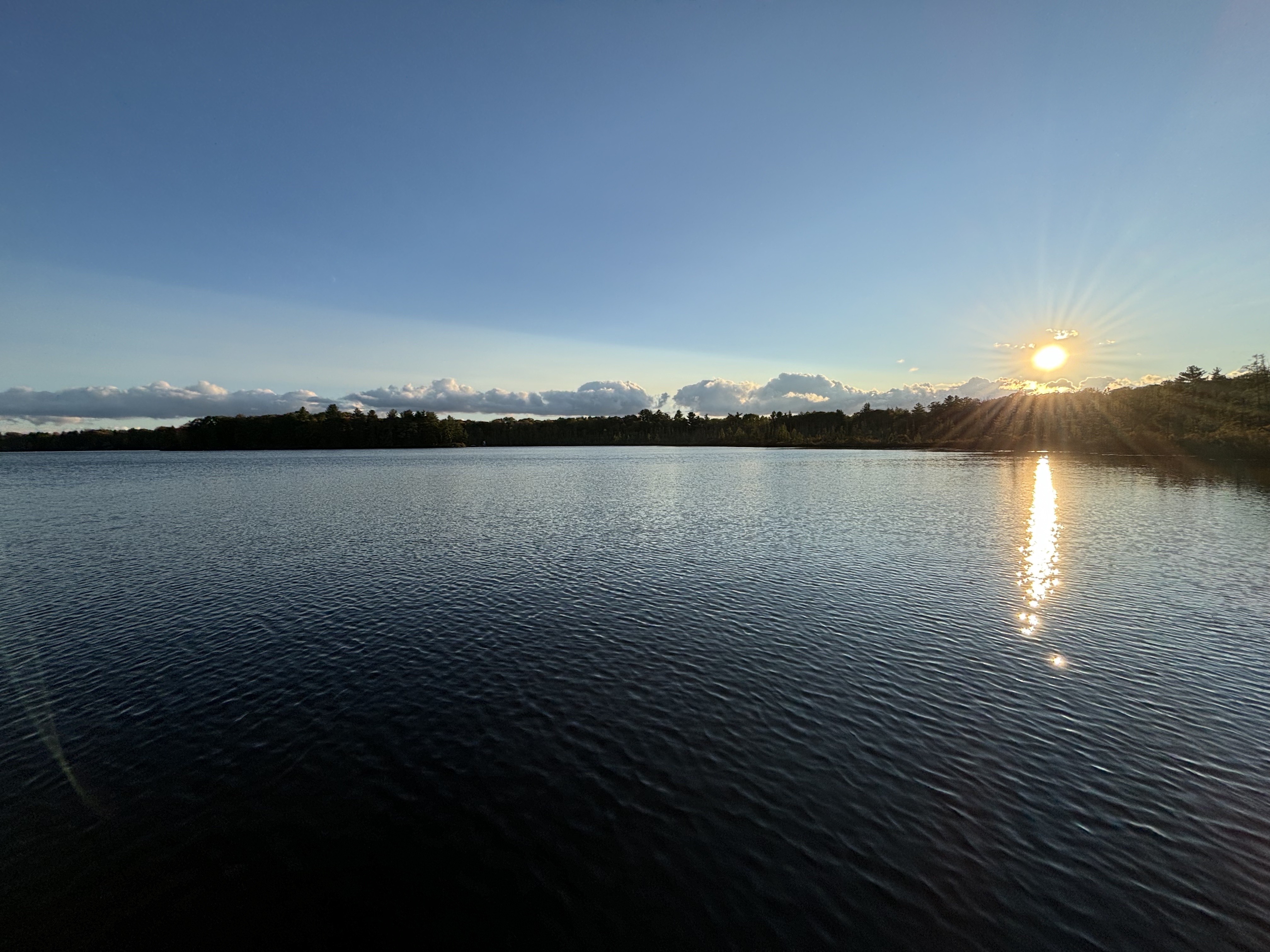
I continued to feel the absence of these friends during the school bus ride up north to Camp Crossroads, the settling into cabins, and eating our first meal in the lodge. At one point I lifted my face up to the sky and said, “they would have loved this”. The moment was broken when some of our group came outside to join me in looking up. Together we breathed in the air that smelled of pine and wood smoke, commented on the beauty of the lake, and chatted about the plan for the evening.
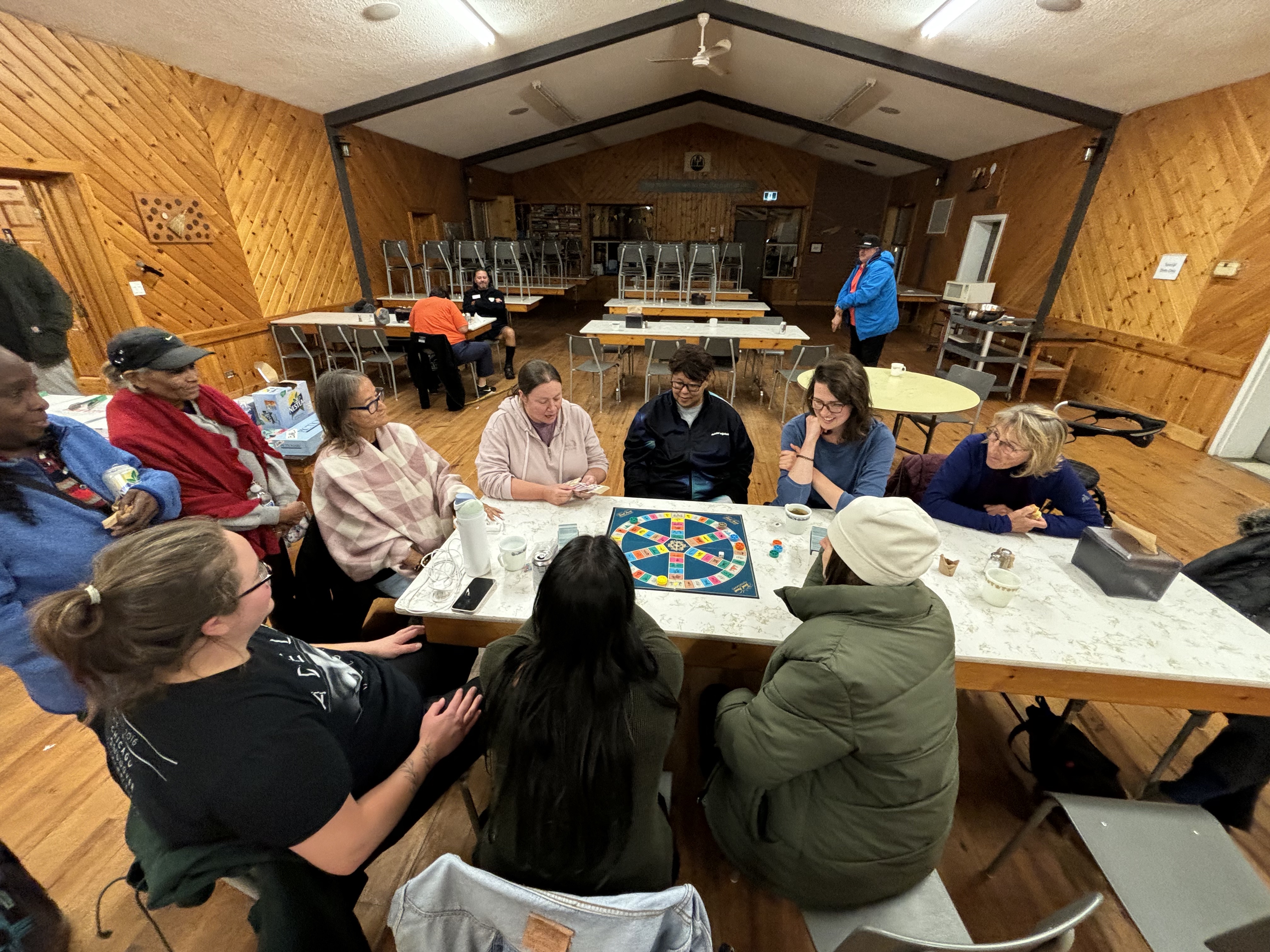
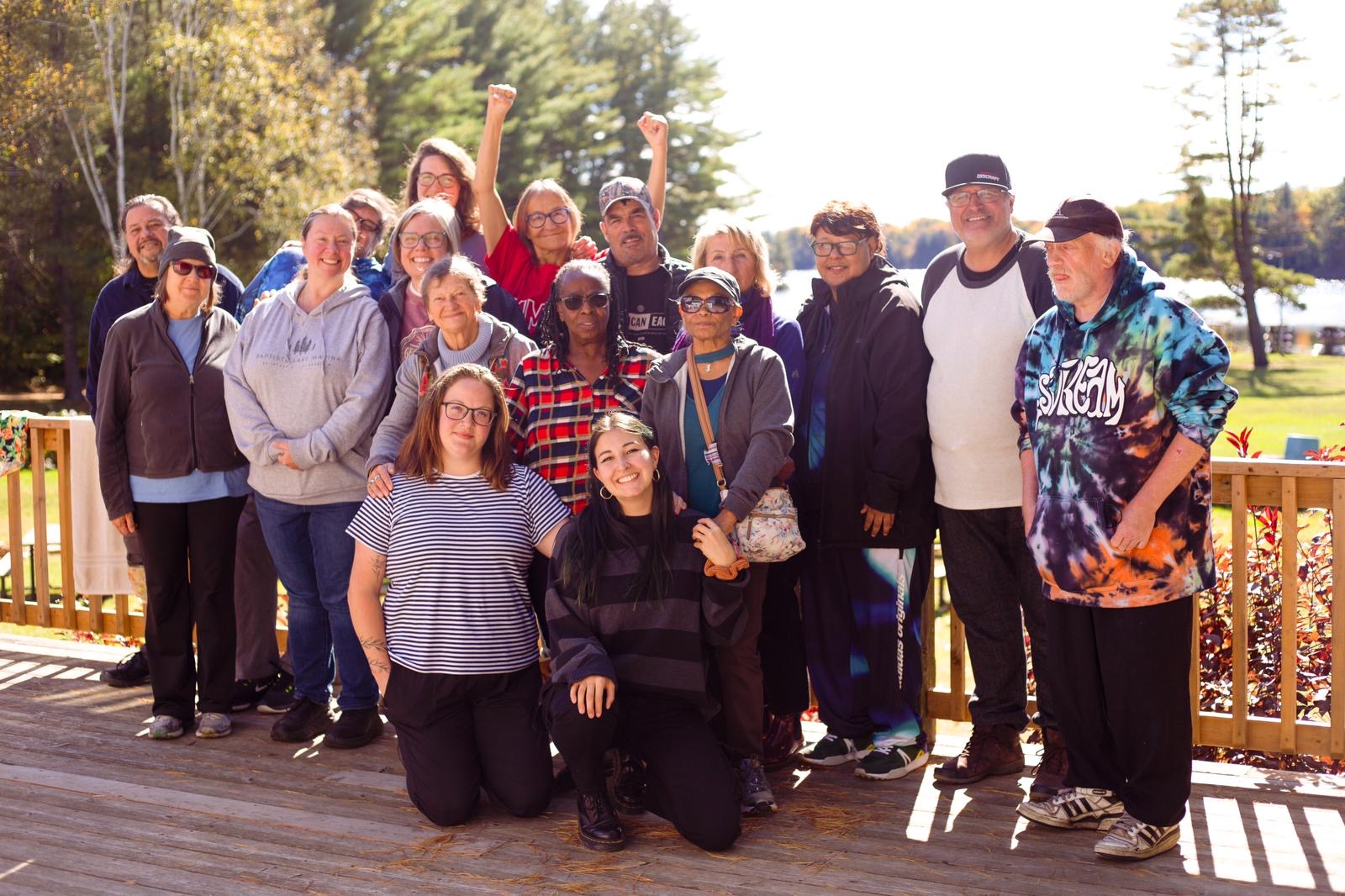
Over the course of the next couple of days, we went on walks, sat on the dock, put together puzzles, played games, ate lots of food, slept, gathered around campfires, took out boats, and talked. Joanna and I jumped in, and very quickly out, of the lake. Meagan’s kindergarten aged daughter Charlotte drew pictures of people as gifts. Some gathered for Morning Prayer. On the last day we sang, shared gratitude, and took communion together. By the end of it people felt closer, some commenting on how they are now more a part of the community.
The retreat helped me to grieve and to hope. I felt able to name that I was missing people. I also got to be present with an amazing group of people who did sign up and get on that bus. Maybe that’s part of what brought about my dream. Life continuing does not mean forgetting. And remembering does not mean excluding. The table is wide and there is always room for more.
I went home to clean up and eat after spending two and a half days at my mother Elaine’s bedside as she journeyed closer to death. My family encouraged me to take a break. I remember eating a small plate of pasta with a single enormous meatball that a friend had made and delivered as a gesture of support. Shortly after washing my face, I received a call that my mom was suddenly moments away from her last breath. I couldn’t bear the thought of not being with her and began to run to the hospital, praying, “Please, let me make it. Please, let me make it.”
It was a holiday Monday, and customary fireworks erupted in the sky ahead of me, feeling as if they were meant for my mom. Breathless, I nearly collapsed as I entered the room, rejoining the circle and tenderly taking my mom’s hand. Within minutes, she passed away.
To ensure I wouldn’t forget, I wrote down my experience of that final weekend with her while planning her funeral. Inspired by those in Scripture who laid down stones to mark significant places and divine experiences, I committed my memories to paper. The more I wrote, the more recollections surfaced. Remembering became an act of honoring both my mom’s life and her sacred end.
For me, remembering isn’t about sifting out the good from the bad; the difficult moments deserve acknowledgment too. To place someone on a pedestal denies the complexity of life. My mom’s life was a blend of sorrow and joy, loss and abundance, and to ignore those contrasts feels disingenuous. It’s not just important that we remember; how we remember matters just as much.
Consider how often history is written by those who believe they’ve won it—the “victors.” This perspective privileges the powerful while marginalizing or even erasing those without a voice. The challenge for us all is that what we remember is subject to interpretation. Memory does not grant us access to all the raw facts of the past; even the facts we recall are shaped by our interpretations. What we remember holds significance for our identities, whether positive or negative.
This is why the collective dimension of memory is essential in a theology of remembering. When we remember together, we connect to past events in meaningful ways. In the case of my mother, I needed to gather with others who grieved her too. Together, we remembered and learned things about Elaine that we might not have otherwise known. Participating in rituals like funerals or communion links communities to past events while fostering meaningful narratives. I believe that remembering the past helps us understand how we relate and engage in the present. My mom’s life taught me about patience and grace—lessons that continue to influence me, and that I never want to forget.
Post Script: I was recently invited to reflect on a theology of remembering and share about it at a gathering called the Dead Heretics Society. I was moved by all of the presentations and the conversation that ensued. With thanks to Carl Amouzou and his team for creating space for, as they describe it, more nuanced, marginal, or grassroots perspectives on theology, culture, and philosophy.
It always happens around Day 3 of my vacation. As I sit in solitude and my body begins to rest, the many things that are hard and contribute to my fatigue rise to the surface. This year in particular has been marked by a large amount of loss in a short period of time. While I am always trying to attend to my grief, 2024 has not made it easy to keep up. Even before the death of one person registered in my heart, another person was just as suddenly gone. Reflecting on this while sitting on a dock and staring out at the water, I began to sense the impending wave of emotion. I’ve learned to not resist.
What ensues is a mix of things. I ugly cry. I pray- sometimes wordlessly, and sometimes with so many words that I can’t help but trip over them. I try to breathe through the pain in a mindful way. At some point I can’t keep my eyes open and fall asleep in the sun. This time that nap was accompanied by a dream that one person had faked their death and I happened to spot them in a crowd. Side note: yes, I’ve told my counsellor about this. Overall, the experience lasts more than a day and is both painful and cathartic.
I say cathartic because I know the stress, the grief and the fatigue cannot simply take up residence in my body. For me, letting these things hibernate means a stiff neck, chest and shoulders. A previous rotator cuff injury makes a re-appearance. My lifelong effort to calm an anxious gut becomes difficult again. Though my demeanor is generally calm (a trait I inherited from my Mom and is not fake), it can sometimes fool me into thinking I am more okay than is true. And so, taking the time to really notice what I am feeling, shaking it awake and giving expression to it has become necessary for my overall health and longevity in my work.
A mess of things happened on that dock at the beginning of August. But, as we often talk about at The Dale, messy is also beautiful. The sun remained in its place and shone down on me, the birds accompanied my prayers, and the life under the water continued its work. I felt comforted by the truth that the world keeps turning and aware of God’s presence. The smell of sunscreen and someone else’s BBQ evoked memories that made me grin. The releasing of emotion finally gave way to a good kind of tired. And then by the second nightfall I fell into a dreamless and deep slumber.
I am now in the latter part of my holidays. I am slowly feeling more rested. I wish I could write that my yearly Day 3+ experience is some kind of magic bullet that makes everything better. Grief, as I’ve learned, is not something that you “get over” but that you move through. Dismissing it, though it might feel easier in the moment, does not make it go away. I find that when I reflect on the person who is gone and allow myself to really feel the loss, there is mysterious space created for healing. Remembrance is an important act of love. And I’m glad to have been reminded of it.
I recently had an overwhelming week at The Dale. Without getting into details, let’s just say I felt emotionally and spiritually spent. While it is not uncommon for my life to feel like a lot, I don’t often feel so downtrodden. Without even the words to describe what was going on in me, the discomfort of it all ballooned.
Before all of this happened, Cate asked if I would be willing to drive her, Matthew, and Declan up to the camp that they all attended and worked at for many summers. Though the three of them are not working there anymore (it’s a new stage of life!), they wanted to visit. I said yes. By the time our trip rolled around, I was especially tender. I didn’t know what I needed but was worried being surrounded by a lot of people at camp was not it. However, the trip went ahead as planned.
Whenever I drive north on Highway 400, I get pangs of nostalgia. My mom grew up in Sudbury, and my grandparent’s cottage was in Killarney. The red rock of the Canadian Shield, the swaying birch trees, and the water all bring me a degree of peace. A lot of the landmarks along the drive have changed, but not all of them- enough remain that bring up old memories.
When we arrived at the camp, I greeted people, found the cabin I would share with Cate, and explained that I would be going into Parry Sound for much of the day. As I drove along the gravel road, surrounded by forest, the lump that had been lodged in my heart for the majority of the week began to dislodge. I still didn’t have any words, just groans and tears. It was all its own kind of prayer.
I eventually got to the beach in town where I laid out a towel, sat and watched the waves, the sailboats, and the handful of children building sandcastles. One little person got into a game of tag with a seagull. I soaked in the sun, read a book in fits and starts, and eventually jumped in the water. As I floated around and stared at the clouds, I felt reminded of how the world keeps moving and growing, even when my own little piece of the world feels stalled and upside-down. I cried some more.
Over the course of the day I ate some food, watched pontoon planes land on the bay, and slowly walked around the docks. Eventually I decided it was time to head back to camp. The groans and tears that accompanied my drive into town, joined me again on that same gravel road. It felt both exhausting and cathartic. I wiped my face and rejoined the group in the late afternoon by settling into a couch in the lodge. From that vantage point I saw Cate working away as though she was still staff. I took a moment to admire the ease with which she was interacting with everyone. I listened to Declan play the keyboard and sing, something I loved doing when he was my housemate for a year. Matthew came to check on me with his characteristic concern and smile. I began to feel more grounded.
We only stayed at camp overnight and into the next day. Cate and I reunited with Dion and shared a good meal. As I reflect now, I think I needed the nostalgia of the highway, the connection to the landscape, the company of Cate and her crew, the alone time, and dinner with my family to find the words to describe my state.
It turns out I had experienced a deep level of hurt during my overwhelming week, and I wasn’t sure that I was allowed to feel it. Over the years, I have gathered up a lot of tools to manage the kind of work that I do. I have a high tolerance for and can help de-escalate heated situations. I feel equipped to practice active listening, which includes hearing about many traumatic things. I know God gives me strength that is not my own. And, I can only hold so much. In a sense, denying my hurt diminished my humanity.
As I write this, the fog I have been in is lifting and the hurt is dissipating. I am realizing that just as I need to ride the wave of grief when it hits, I need to address pain. When I do, the noise is calmed enough that I can again hear God’s voice, reminding me of where I have been called and that I am loved. Without even realizing it, I started to hear those truths whispered as I cried amongst the trees.
I am frequently asked: how do you take care of yourself? Some people want to specifically know how I manage in the work that I do. Others wonder what it looks like to hold the various aspects of my life in balance. As I think about answering, usually the first thing that comes to mind is, “I have no idea what I’m doing.” The truth is, I am stumbling along, just trying to take the next (hopefully) best step. Upon further reflection, I realize there are a number of values that have been instilled in me by mentors, pastors, friends, and family. In the moments when I am struggling to know what to do, I lean on the wisdom of others.
SABBATH
Marva Dawn says, “A great benefit of Sabbath keeping is that we learn to let God take care of us — not by becoming passive and lazy, but in the freedom of giving up our feeble attempts to be God in our own lives.” Sabbath is fundamental to my wellbeing. I am reminded that I cannot do it all, nor am I required to. And whew, is that ever a relief. I hold Sabbath on Fridays. The outgoing message on my phone alerts people to this. I’m not saying it is easy, or that there aren’t occasionally emergencies or other things that require my attention. I am though convinced it is worth it. It has been in the quietest moments of rest that I find myself reminded love is not earned by doing. I am, WE ARE, simply beloved- though there is oftentimes nothing simple about embracing that truth.
MUTUALITY
At The Dale I am not just doing something for someone else. Instead, the invitation is for us to do something together. We are all made to both give and receive, and we lose a part of ourselves if we are always the giver or always the receiver. I call this mutuality. Holding this posture also invites me to see every person I encounter as unique, noticing that they have their own set of experiences which contribute to the way the world is viewed. In turn, I then have to allow people to see me. As relationship develops, there is opportunity for me to both offer care and receive it. Mutuality can at first feel quite vulnerable. The typical power dynamic suddenly shifts. For me, embracing both sides is life-giving and I think one of the biggest contributors to my longevity in this work.
COMMUNITY
I cannot do this life alone. I need people. I need those who know my strengths and my weaknesses, and who out of love and care call me out on things; who I can share the hard stuff with; who I can laugh with until I’m crying. And I need to be that person for others. I am so grateful to have friends who are all these things to me. I believe that we humans are built for community, which is why isolation (which is different than choosing solitude) is so debilitating and lonely. At The Dale it has been very important to grow a staff team, one where we know one another well and trust that we all have each other’s backs. The Dale as a whole spends a lot of time together, around tables, outside, in various spaces around the neighbourhood. We eat, we make art, we sing, we cry, we pray, we waste time together- all of which serves to nurture community.
COUNSELLING
I am a big fan of therapy. I see a counsellor nearly every other week. I also see people who function as spiritual directors and coaches. This might increase if I am in crisis, but it does not decrease when things are steady. I deeply value the active listening, question-asking, feedback, homework, prayer, and wise counsel of these sages. I have come to better understand myself through their care and been given tools to better manage my life generally. I know it is a privilege to have the resources for this type of support, something I do not take for granted. I think in the absence of counselling, the necessity of community is yet again high-lighted.
HOME
I love my family and the life we have built together. I count being a partner to Dion and a mother to Cate two of the greatest gifts in my life. Dion and I have seen each other at our best and at our worst. We have weathered a lot of hard stuff, and as one friend recently commented, I still laugh the loudest with him. When I look at Cate it is like my heart is walking around on two legs. With all of this in mind, it has been very important that I not let work consume me. As a family we spend a lot of time together, even in this new stage where Dion lives in Long Term Care and Cate is launching into adulthood. We have developed what some think of as a ridiculous amount of traditions and we stick to them. Dion and Cate participate in the life of The Dale whenever possible. My home life helps to ground me.
I was going to make prayer a section of its own, but I realized that for me, it has to cover everything. At its most basic, prayer is a conversation, and folks, I tend to be in conversation a LOT- sometimes it is calm and peaceful, other times it is choppy and frantic. I ask a lot of questions. I wail. I cheer. I hope. Always I am given strength that is not my own, which reminds me of one of my mother’s favourite Bible verses: “My grace is sufficient for you, for my power is made perfect in weakness.” I suppose I have buried the lead. How do I manage this challenging and beautiful life? Through prayer and by grace. Both of which have directed me to Sabbath, Mutuality, Community, Counselling, and Home.
It started with a conversation in Seattle. I had been told I should “really meet Jenna Smith from Montreal” and we were at the same conference. We grabbed some time together to chat about my wonderings around starting a fresh expression of StreetLevel, the Canadian network of front-line workers that had been an important part of my story when it was active. Jenna mentioned Daria Nardozza, the person building a Domestic Network within Kentro, a connecting point for Canadian Christian relief and development organizations and professionals. She suggested we meet.
Jenna, Daria and I went on to connect via a zoom call. We introduced ourselves and learned about each other’s work. We noticed a shared desire to organize and bring people together. The time went too fast, so we determined to meet again. Not long after, Daria invited me to join her Advisory Team. I invited her to attend Story Day: Hospitality, an event inspired by StreetLevel. We both said yes.
Daria flew to Toronto from Montreal to attend Story Day last fall. We then spent the evening around a table with a variety of friends. She slept over at my house. The next morning she and Carl Amouzou (another friend who travelled to Toronto for Story Day) joined us at The Dale, the community organization and church I work at, for our breakfast to go and some impromptu aerobics led by a community member. I always find spending concentrated time with others helps to deepen relationship, and this was exactly that kind of experience.
It has been a year since the inception of Kentro’s Domestic Network. During that time, many people have helped in the process of discerning how to draw charities and churches together. Meanwhile, I have continued to collaboratively work with a number of people to animate gatherings for those engaged in addressing poverty and injustice in the spirit of StreetLevel. What I love is how these things overlap and hold space for the other.
While at a recent Kentro Forum, I shared about what Jane Jacobs refers to as the “weaving of an urban fabric”. One definition of weaving is, “the act of making something by combining different parts”. I believe there is a lot of weaving going on right now. People from a variety of contexts are seeking connection. The shape of the fabric is still emerging, which is both scary and exciting. I think that what will ensure a tight weave is our relationships. It can all start with a conversation, just like the one Jenna and I had that day in Seattle.
This year, Easter coincided with multiple deaths in The Dale community. The result for me has been a real wrestling with resurrection. In the Christian faith, we celebrate that Jesus died and then came back to life. There is promise in this that we too will ultimately overcome death, but for now we still have to stare it in the face. Three friends, in the span of mere weeks, are gone from here arguably too soon. Resurrection seems very far off.
Death is an experience, as the band Mumford and Sons sings, that is so “full”. There is no mistaking that the person is gone, and yet it doesn’t make any sense. Clinging to a future hope while managing the reality of now can be hard work. It has me exploring the word “resurrection”, and delving deep into the story of Jesus, wondering again about what it all means.
The origin of the word resurrection means “to stand” or “to rise up”. Some dictionaries define it as: “the act of bringing something that had disappeared or ended back into use or existence”. This actually brings to mind the ways that I have seen forms of resurrection. Like when a tree buds in the spring, or a broken relationship is restored, or sobriety is found, or a family is reunited, or health returns after an illness.
In Scripture, all of the post-resurrection appearances of Jesus center on the physical. Jesus didn’t speak with a loud voice from the sky, He instead showed up with hands, feet, and scars. He embraced Mary, made footprints on the road with people, chewed on a piece of fish, and made a campfire on the beach to cook breakfast for his friends. It was in the presence of skin and bones that the disciples came to faith. Jesus turned the trauma of his death into communion with His people.
I love that Jesus used ordinary and concrete things to ground the divine. It makes me think we can do the same: that there is a sacredness in gathering, in breaking bread together, in doing dishes, in walking and leaving footprints, in sharing our scars. When I take a step back at a Dale drop-in and listen to the hum of conversation, notice the cups of coffee being shared, watch two people forgive each other, see the joy on someone’s face when they receive a compliment, I do believe I am experiencing communion while catching a glimpse of resurrection.
In the middle of this season of loss, we experienced a person being brought back to life during a gathering of The Dale. It was at our Bible Study, while we were talking about resurrection that this person died, was revived and about a half hour later walked away. It was astonishing. It made me appreciate even more how shocking it would have been to see Jesus a full three days after death. I can’t imagine what it would be like to have one of my recently deceased friends show up, even if it is exactly what I long to have happen.
The profound mystery that is the resurrection is one I do not expect to entirely understand on this side of things. In the meantime, my prayers for healing here and now will never stop. I desire for all that has been taken, broken, mistreated, wronged, and forgotten to be restored. The resurrection of Jesus is the promise I hang on to, sometimes by the skin of my teeth, when healing does not look like what I might expect or hope in the present.
You may have heard this story before, as I tell it with some frequency and with permission. He was brought to The Dale by a mutual friend. My first impression was that he cut an imposing figure: a man of heft, with a fist full of skull rings and a guitar slung across his back. I remember him looming over me and with an intimidating voice asking, “what IS this place?” I looked up and said, “we’re The Dale and you’re welcome to stay”. That was the beginning of our relationship.
Snake Man, as he first introduced himself, lived in a local rooming house with snakes as companions. At the time, his life was very solitary. His early forays into The Dale were often fraught with challenge, as his anger could be quick and fierce. I could tell that he wanted community but struggled to know how to embrace it. It wasn’t uncommon for him to leave in a huff and not return for days. During one of his lengthier absences, three of us went looking for him. We called, knocked on his door and ultimately tried to throw pebbles at his third story window. We didn’t find him that day, but he heard about our effort. For Snake Man it was significant that we sought him out. It was a turning point for us.
Along the way, as trust slowly built, Snake Man revealed more and more about himself, including his given name: Douglas or Doug for short. Doug became a fixture at The Dale, coming to every drop-in, every outing, every Sunday service. He would punctuate all of our gatherings with music by playing guitar and inviting others to sing. The two of us connected around music a lot, Doug strumming and me on the piano. Doug would form and join and break-up bands all the time, and so I counted it an honour that he assured me we would play together forever. He once dubbed us “Merinn”, which stood for Me and Erinn. Our other name was The Noisy Jesus Band, appropriate I thought given Doug’s preferred volume (LOUD) and, as he put it, our desire to play for God.
In addition to music, Doug loved drawing. He came to share how, as a child, he would spend all of his time with pen and paper. He attended Central Tech, a high school in Toronto known for its specialized arts program. Doug dwelled in fantasy, preferring to create monsters. This fixation nurtured a love for horror films and even led to an acting part in a B level movie called ‘Things’. Doug often asked us to pull up clips of the film on our phones to show others. He relished in seeing people’s reactions to his presence on the screen. As an avid movie fan, he was regularly encouraging us to have field trips to the theatre, which did happen a handful of times. Doug always wanted to document such experiences and would bring a random scavenged device (a phone, an ancient blackberry, a camera) to record it all.
In the early days of our relationship, Doug could scare me. We once had a very difficult conversation in the Thrift Store, the location of one of The Dale’s drop-ins at the time. After a lengthy barrage of words from him, I was nearly at the end of myself and started to cry. The tears immediately impacted him, and I saw something change. It was as though the Doug I knew was hiding under the hard exterior finally came out. He softened. Over time, that softening continued. It’s not that there wasn’t any more anger, it’s that the management of it changed. It was less explosive. I think Doug began to trust that the things anger was masking were safe with us. I slowly began to feel safe with him too.
Doug began to repeatedly offer me/us care. When Dion was falling with some frequency due to his MS, Doug said I could call day or night and he would come and pick him up. If a community member needed something, he would do his best to find it. He gave gifts with abandon. Albeit reluctantly, Doug even (occasionally) learned to turn down the volume on his amp or even go acoustic when appropriate. He became my constant musical companion at our Sunday Service, missing maybe a handful of Sundays over a decade.
It was his missing two Sundays recently that caused us pause. We spoke this past Monday though, and then played phone tag during the week. He hadn’t been feeling well, and we were encouraging him to see a doctor. Joanna and I went to check on him on Saturday, which is when we found our beloved friend deceased. I am in shock. None of us can believe it.
Doug, I don’t like writing about you in the past tense. In fact, I hate it. I want to share more things about you, like how much you love to eat chicken balls with sweet and sour sauce, how you think Jeff Beck was the greatest guitarist of all time, and how you became the unofficial archivist of The Dale. I am expecting you to sneak up behind me, put your hand on my shoulder and say your usual, “acknowledge me”. I want to play our favourite songs together and tell you we have time for one more. You showed me that it is possible for a person to change and experience transformation a little bit at a time, while not giving up one’s essence. You were unabashedly you, in good times and bad. I wish we could have helped more with some of your deepest challenges. And, I am so proud of all you overcame. Thank you for being my friend. Before parting ways, you would always say “Love you, God bless”.
Love you Dougie. God bless.
Douglas Gordon Bunston February 11th, 1952 – March 23rd, 2024
Years ago, Dion and I purchased a wheelchair accessible van with the financial help of many people. At the time Dion was in a mobility scooter and could ride into the van, transfer into the front seat, and drive using hand controls. Even after a wheelchair became necessary for Dion and he stopped driving, it remained an important form of independence for him. Our family can get around together, including to places beyond the boundaries of Wheel Trans (the accessible arm of public transit in Toronto). Since Dion’s move into Long Term Care it has helped us maximize time together. The van has also been an important part of my work at The Dale. It has served as an office, a storage unit, and a community outreach vehicle.
Not even two weeks ago the van died. The end came as a surprise. I took it in to have the brakes looked at, only to be told there were much bigger problems that couldn’t be fixed. We got a second opinion which matched the first.
When I told folks at The Dale, I wasn’t sure what the response might be. I get that having a vehicle is a privilege, one that most of our community does not have. People expressed such concern and said they would pray for our family. Once again, I felt cared for and seen. I was also reminded that the vehicle has meant a lot to many people, including those who like Dion, use mobility devices. It has carried people to picnics and restaurants and funerals and waiting rooms and court. Once we had to transport someone’s beloved deceased pet to a clinic. We have rolled down the windows and blared music while travelling on the highway. There are a lot of memories.
During last Thursday’s Breakfast-to-Go, someone expressed to me their true concern for Dion in all this. They went on to recount some of their favourite experiences of the van. Shortly after, my co-workers Joanna, Meagan and Olivia reported on two exchanges they had with people about the van. One person expressed their true sadness about its demise and how it really deserves a proper burial. Another mentioned how helpful it has been to see it parked in the neighbourhood because it signals that I am around. I wanted to both grin and have a little cry. Who knew a beat-up burgundy Toyota could have such an impact? I’m grateful that we have been able to share it in such a way that people came to count it their own.
The van got towed away to a scrap yard last week. And so, with very little fanfare, it is now gone. We’re not really sure what is next. There are pros and cons to every solution we are considering, including not having a vehicle. I’m glad that the van, while we had it, was used to its full potential. I hope that whatever comes next will serve our family and extended community just as well.
The windshield of the van was often decorated with gifts, in this case paper cutouts, by community members of The Dale.
It was an accessible restaurant for a couple of years. Dion and I would occasionally go, entering through a door that was both wide and street-level. One day we arrived to notice that the door was locked. I went around to the other side of building to discover that they had reconfigured the space. Now the only entrance was up three large steps. “But look!” the manager said, “The door is at least automatic”. I asked if there was any way they could let us in the other door. The answer was a hard no. “We can help him walk up the steps!” To which I said, “my husband cannot transfer out of his wheelchair. There is no walking up the steps. Do you realize that you have made a once accessible place into the opposite?” I felt enraged on Dion’s behalf.
This is but one of many stories that could be told about the general lack of accessibility in our society. My own awareness of it was heightened when my mother became quadriplegic, with some very limited use of her right hand. Between that, Dion’s journey with Multiple Sclerosis, and the many people in my community at The Dale who require mobility supports of various kinds, my learning has expanded. This does not mean that I completely understand how it feels to experience accessibility limitations- I would never dare to claim that I do. It does mean that my eyes are open, and I feel the challenge to make accessibility a priority. It is, in my opinion, a matter of hospitality.
My greatest teachers in this are the ones who have to navigate obstacles every single day. I have learned that the swing of a door matters, as does the placement of an automatic door button; that one step is too many; that sometimes the only way a person can manage to drink out of a cup is with a straw; that support animals are life-changing; that the height of sinks and toilets and counters can be prohibitive to some people; that not being able to participate in events because you can’t get in is heartbreaking.
Buildings of all kinds have not been designed to be inclusive. I’m also very aware of the cost that is involved in making a space accessible. We had to build a ramp for my mom. And then when Dion required a new level of care, we had to renovate our home. We could not have made that happen without the financial support of our community. Our connections afforded us a certain privilege. I reflect on this a lot. What I long for is our experience to be replicated for everyone.
I imagine that an important way forward is to have anything new designed for all. I recently read about how the remote control was invented for people with limited mobility, and now is a convenience for all. Similarly, SMS text messaging was first created for people who are deaf and is now a preferred method of communication. It is so easy to take those two things for granted but imagine what they mean for someone who lacks mobility or can’t talk on the phone. Accessibility for all concerns and impacts every aspect of life.
As I walked out of that restaurant I mentioned, I was followed by one of its employees. With tears in her eyes, she explained we weren’t the first to mention the issue of the entrance and that she would be sure to talk to the manager. Seeing someone not be able to get in humanized the issue for that person. It was no longer just a door, but an obstacle. I hope that for her, and for her manager the experience will bring about tangible change.
I often think about the Biblical story of the paralyzed person who was lowered from the roof by his friends in order to see Jesus. I desire to be that kind of friend. It also reminds me that our bodies are not static. What we need today might be different tomorrow. For me, it has started with asking: for people to get around freely and in autonomy, how can we all contribute to and conceive a world that’s accessible to them and ultimately to all?



 ERINN OXFORD