Speaking Their Names

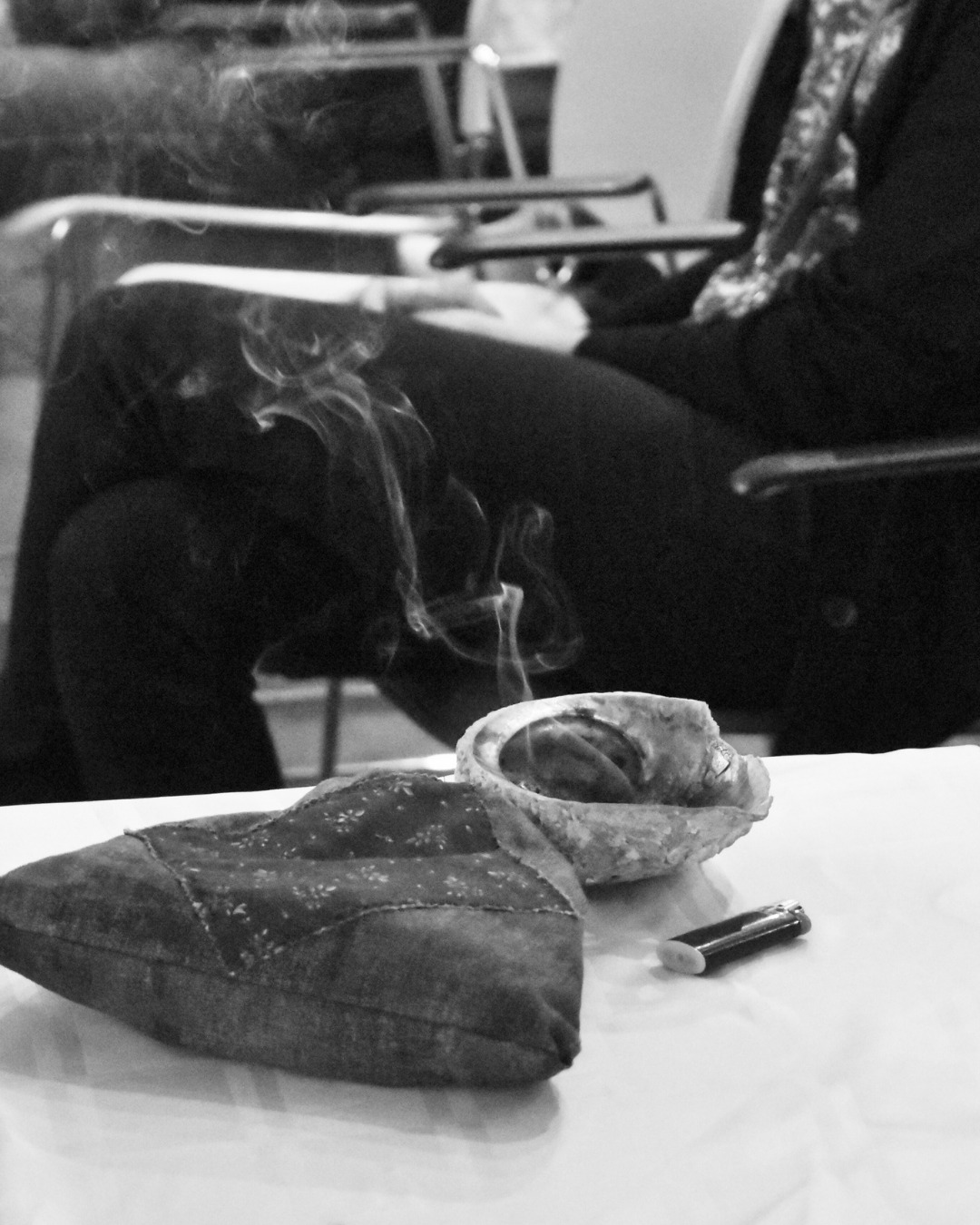
The room was already prepared when we arrived: vases of long-stemmed yellow roses graced the center of each table, a guest book waited near the entrance for people to sign, and a screen scrolled through the names of members of the Parkdale Activity Recreation Centre (PARC) who had died over the past five years—many of whom were also deeply connected to The Dale.

Over 126 names.

As I read through the list in silence, I could feel the grief rising in me. It stopped just behind my eyes—or so it seemed—hovering close to the surface, unsure how to make its way out.

As friends and partners, The Dale and PARC came together to create this service of remembrance. It had been a long time since PARC was able to hold a memorial of this kind, and we were eager to help. Joanna and I met several times with staff members to plan, and the whole team took part.

During the service, I sat behind the keyboard beside Max and Isaac on guitar and bass. Together, we created pauses between the reading of names with songs—songs the whole room joined in singing.

An Indigenous Elder opened the gathering, reminding us that those who have gone before us are our ancestors—people we can continue to hold close.

It was a hard afternoon. And a good one. Strange how something can be both heavy and freeing at once. We needed to speak our friends’ names aloud, and to do it together. Over the course of the afternoon, a little air was released from the growing balloon of grief. The pressure behind my eyes slowly eased as the tears came and the memories resurfaced, all held within a room full of people who understood.

I left PARC feeling tender. I know the depth of my grief reflects the depth of my love. Still, at the end of the day, death hurts. Though I cling to my faith that death is not the end, I miss so many people. The number keeps growing, and is beyond 126.

And yet, even in the ache, there is something unbroken: the call to keep showing up, to keep building community, to keep loving. As Mary Oliver wrote:

“To live in this world
you must be able
to do three things:
to love what is mortal;
to hold it
against your bones knowing
your own life depends on it;
and, when the time comes to let it go,
to let it go.”

I’m still learning how to do that. But I think that’s part of what it means to be alive.

The Power of Collective Memory: Honoring the Past to Shape Our Present

I went home to clean up and eat after spending two and a half days at my mother Elaine’s bedside as she journeyed closer to death. My family encouraged me to take a break. I remember eating a small plate of pasta with a single enormous meatball that a friend had made and delivered as a gesture of support. Shortly after washing my face, I received a call that my mom was suddenly moments away from her last breath. I couldn’t bear the thought of not being with her and began to run to the hospital, praying, “Please, let me make it. Please, let me make it.” 

It was a holiday Monday, and customary fireworks erupted in the sky ahead of me, feeling as if they were meant for my mom. Breathless, I nearly collapsed as I entered the room, rejoining the circle and tenderly taking my mom’s hand. Within minutes, she passed away.

To ensure I wouldn’t forget, I wrote down my experience of that final weekend with her while planning her funeral. Inspired by those in Scripture who laid down stones to mark significant places and divine experiences, I committed my memories to paper. The more I wrote, the more recollections surfaced. Remembering became an act of honoring both my mom’s life and her sacred end.

For me, remembering isn’t about sifting out the good from the bad; the difficult moments deserve acknowledgment too. To place someone on a pedestal denies the complexity of life. My mom’s life was a blend of sorrow and joy, loss and abundance, and to ignore those contrasts feels disingenuous. It’s not just important that we remember; how we remember matters just as much.

Consider how often history is written by those who believe they’ve won it—the “victors.” This perspective privileges the powerful while marginalizing or even erasing those without a voice. The challenge for us all is that what we remember is subject to interpretation. Memory does not grant us access to all the raw facts of the past; even the facts we recall are shaped by our interpretations. What we remember holds significance for our identities, whether positive or negative.

This is why the collective dimension of memory is essential in a theology of remembering. When we remember together, we connect to past events in meaningful ways. In the case of my mother, I needed to gather with others who grieved her too. Together, we remembered and learned things about Elaine that we might not have otherwise known. Participating in rituals like funerals or communion links communities to past events while fostering meaningful narratives. I believe that remembering the past helps us understand how we relate and engage in the present. My mom’s life taught me about patience and grace—lessons that continue to influence me, and that I never want to forget.

Post Script: I was recently invited to reflect on a theology of remembering and share about it at a gathering called the Dead Heretics Society. I was moved by all of the presentations and the conversation that ensued. With thanks to Carl Amouzou and his team for creating space for, as they describe it, more nuanced, marginal, or grassroots
perspectives on theology, culture, and philosophy. 

525600 Minutes

As we hit a decade of being The Dale, I have been in a reflective mood. Most recently this has been about our staff team. Not everyone might know that ten years ago I was the only staff member. With time that number has blossomed into our current team of four. To say we experience a lot together is an understatement. While each year has brought its own challenges, I think navigating a second year of pandemic life in 2021 can be categorized as unique (though that sentiment is now bleeding into the first few months of 2022).

There are 525600 minutes in a year. As a familiar song asks, “how do you measure a year in a life? In daylights, in sunsets, in midnights, in cups of coffee, in inches, in miles, in laughter, in strife?” I don’t know exactly how many of these minutes The Dale team has been together, but I know the number is high. It is also hard to gauge how many cups of coffee we have consumed, how many bouts of laughter we have shared, how many steps we have walked along Queen Street West, how many pieces of PPE we have worn, how many tears have been shed.

While there is a strong rhythm of life at The Dale, every day brings surprises. Sometimes these are happy: we have a great interaction with a stranger, or the exact thing we are running low on shows up as a donation, or we are invited to do something for a community member that is both random and wonderful. Sometimes these are sad: we can’t find housing for a friend who is exhausted from living outdoors, or we have to call 911, or we get the dreaded news that someone else has died.

So, given the complexity of our day-to-day life, how DO we measure a year? The same song suggests, “how about love? Measuring love? Seasons of love?” Yes. This I can do, not because love is easy, but because there are markers for it, including patience, kindness, a lack of envy, boasting or pride. Love does not dishonour others and is not easily angered. Love protects, trusts, hopes and perseveres. I bear witness to how we are working to love one another as a team, including the way we check in with each other and pray together (A LOT). We talk through things. I am confident we have one another’s backs.

Joanna, Meagan and Olivia are precious to me. In 2021 they stood with me during some very dark days, practically and emotionally. I know I can be vulnerable and transparent with them. They support and encourage me in my role at The Dale and even cheerlead my wildest ideas. We are there for each other in all these ways. Last year brought the four of us challenge, fatigue, and grief. Fortunately, we didn’t have to go through it alone. Believing that joy is not simply an emotion, we even found it in the hardest of things.

We like to say that life is both messy and beautiful, generally speaking and specifically at The Dale. We want to live into that tension, because both are true- one does not cancel out the other. While I might not remember every moment of 2021, I do identify it as another season of love for our team. I am glad to already be into the next 525600 minutes with them and our community.