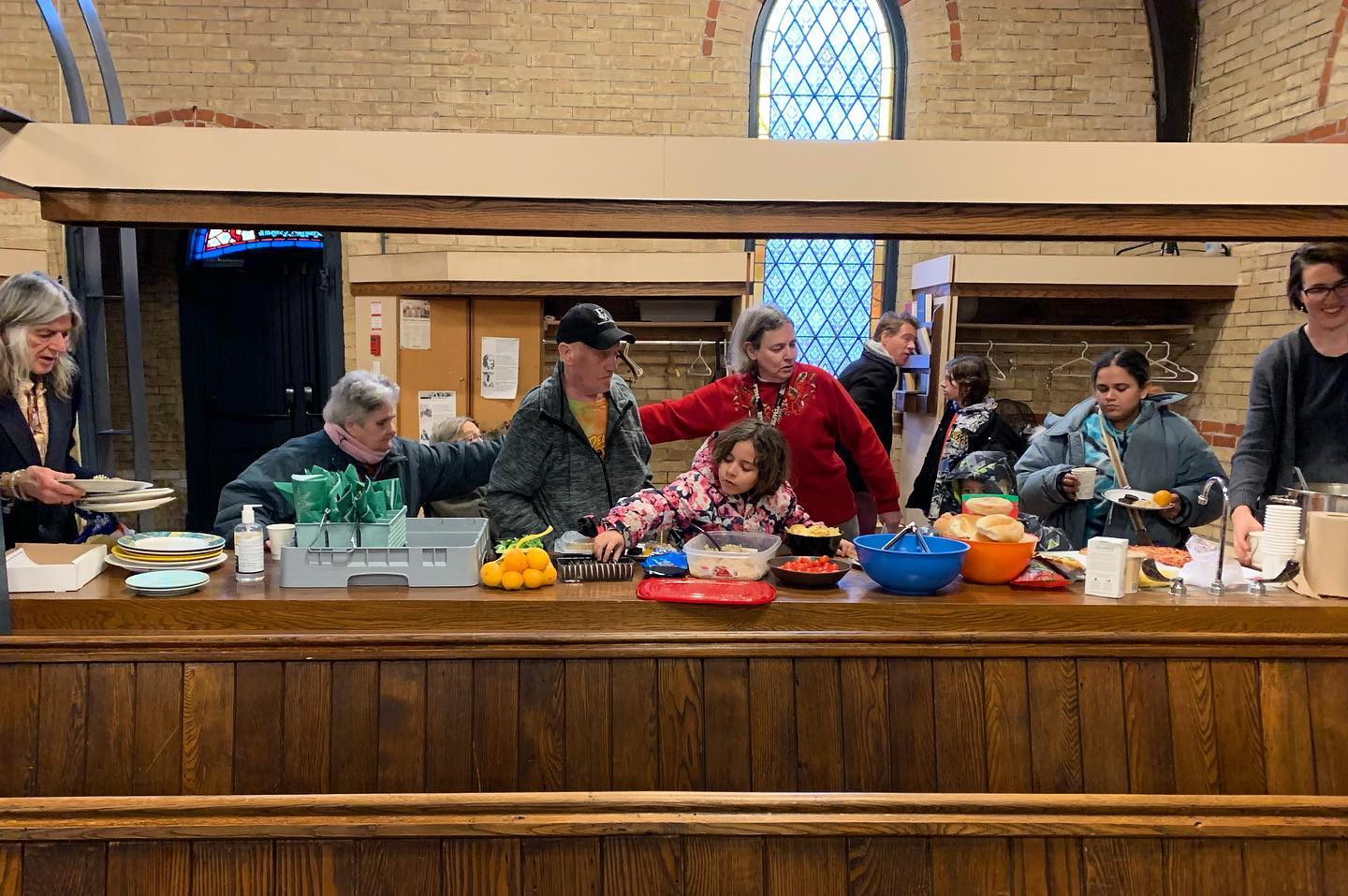
Holistic Wellbeing: The Importance of Sabbath, Mutual Care, and Community

I am frequently asked: how do you take care of yourself? Some people want to specifically know how I manage in the work that I do. Others wonder what it looks like to hold the various aspects of my life in balance. As I think about answering, usually the first thing that comes to mind is, “I have no idea what I’m doing.” The truth is, I am stumbling along, just trying to take the next (hopefully) best step. Upon further reflection, I realize there are a number of values that have been instilled in me by mentors, pastors, friends, and family. In the moments when I am struggling to know what to do, I lean on the wisdom of others.

SABBATH

Marva Dawn says, “A great benefit of Sabbath keeping is that we learn to let God take care of us — not by becoming passive and lazy, but in the freedom of giving up our feeble attempts to be God in our own lives.” Sabbath is fundamental to my wellbeing. I am reminded that I cannot do it all, nor am I required to. And whew, is that ever a relief. I hold Sabbath on Fridays. The outgoing message on my phone alerts people to this. I’m not saying it is easy, or that there aren’t occasionally emergencies or other things that require my attention. I am though convinced it is worth it. It has been in the quietest moments of rest that I find myself reminded love is not earned by doing. I am, WE ARE, simply beloved- though there is oftentimes nothing simple about embracing that truth.

MUTUALITY

At The Dale I am not just doing something for someone else. Instead, the invitation is for us to do something together. We are all made to both give and receive, and we lose a part of ourselves if we are always the giver or always the receiver. I call this mutuality. Holding this posture also invites me to see every person I encounter as unique, noticing that they have their own set of experiences which contribute to the way the world is viewed. In turn, I then have to allow people to see me. As relationship develops, there is opportunity for me to both offer care and receive it. Mutuality can at first feel quite vulnerable. The typical power dynamic suddenly shifts. For me, embracing both sides is life-giving and I think one of the biggest contributors to my longevity in this work.

COMMUNITY

I cannot do this life alone. I need people. I need those who know my strengths and my weaknesses, and who out of love and care call me out on things; who I can share the hard stuff with; who I can laugh with until I’m crying. And I need to be that person for others. I am so grateful to have friends who are all these things to me. I believe that we humans are built for community, which is why isolation (which is different than choosing solitude) is so debilitating and lonely. At The Dale it has been very important to grow a staff team, one where we know one another well and trust that we all have each other’s backs. The Dale as a whole spends a lot of time together, around tables, outside, in various spaces around the neighbourhood. We eat, we make art, we sing, we cry, we pray, we waste time together- all of which serves to nurture community.

COUNSELLING

I am a big fan of therapy. I see a counsellor nearly every other week. I also see people who function as spiritual directors and coaches. This might increase if I am in crisis, but it does not decrease when things are steady. I deeply value the active listening, question-asking, feedback, homework, prayer, and wise counsel of these sages. I have come to better understand myself through their care and been given tools to better manage my life generally. I know it is a privilege to have the resources for this type of support, something I do not take for granted. I think in the absence of counselling, the necessity of community is yet again high-lighted.

HOME

I love my family and the life we have built together. I count being a partner to Dion and a mother to Cate two of the greatest gifts in my life. Dion and I have seen each other at our best and at our worst. We have weathered a lot of hard stuff, and as one friend recently commented, I still laugh the loudest with him. When I look at Cate it is like my heart is walking around on two legs. With all of this in mind, it has been very important that I not let work consume me. As a family we spend a lot of time together, even in this new stage where Dion lives in Long Term Care and Cate is launching into adulthood. We have developed what some think of as a ridiculous amount of traditions and we stick to them. Dion and Cate participate in the life of The Dale whenever possible. My home life helps to ground me.

I was going to make prayer a section of its own, but I realized that for me, it has to cover everything. At its most basic, prayer is a conversation, and folks, I tend to be in conversation a LOT- sometimes it is calm and peaceful, other times it is choppy and frantic. I ask a lot of questions. I wail. I cheer. I hope. Always I am given strength that is not my own, which reminds me of one of my mother’s favourite Bible verses: “My grace is sufficient for you, for my power is made perfect in weakness.” I suppose I have buried the lead. How do I manage this challenging and beautiful life? Through prayer and by grace. Both of which have directed me to Sabbath, Mutuality, Community, Counselling, and Home.

When Easter and Death Collide

This year, Easter coincided with multiple deaths in The Dale community. The result for me has been a real wrestling with resurrection. In the Christian faith, we celebrate that Jesus died and then came back to life. There is promise in this that we too will ultimately overcome death, but for now we still have to stare it in the face. Three friends, in the span of mere weeks, are gone from here arguably too soon. Resurrection seems very far off. 

Death is an experience, as the band Mumford and Sons sings, that is so “full”. There is no mistaking that the person is gone, and yet it doesn’t make any sense. Clinging to a future hope while managing the reality of now can be hard work. It has me exploring the word “resurrection”, and delving deep into the story of Jesus, wondering again about what it all means. 

The origin of the word resurrection means “to stand” or “to rise up”. Some dictionaries define it as: “the act of bringing something that had disappeared or ended back into use or existence”. This actually brings to mind the ways that I have seen forms of resurrection. Like when a tree buds in the spring, or a broken relationship is restored, or sobriety is found, or a family is reunited, or health returns after an illness. 

In Scripture, all of the post-resurrection appearances of Jesus center on the physical. Jesus didn’t speak with a loud voice from the sky, He instead showed up with hands, feet, and scars. He embraced Mary, made footprints on the road with people, chewed on a piece of fish, and made a campfire on the beach to cook breakfast for his friends. It was in the presence of skin and bones that the disciples came to faith. Jesus turned the trauma of his death into communion with His people.

I love that Jesus used ordinary and concrete things to ground the divine. It makes me think we can do the same: that there is a sacredness in gathering, in breaking bread together, in doing dishes, in walking and leaving footprints, in sharing our scars. When I take a step back at a Dale drop-in and listen to the hum of conversation, notice the cups of coffee being shared, watch two people forgive each other, see the joy on someone’s face when they receive a compliment, I do believe I am experiencing communion while catching a glimpse of resurrection. 

In the middle of this season of loss, we experienced a person being brought back to life during a gathering of The Dale. It was at our Bible Study, while we were talking about resurrection that this person died, was revived and about a half hour later walked away. It was astonishing. It made me appreciate even more how shocking it would have been to see Jesus a full three days after death. I can’t imagine what it would be like to have one of my recently deceased friends show up, even if it is exactly what I long to have happen. 

The profound mystery that is the resurrection is one I do not expect to entirely understand on this side of things. In the meantime, my prayers for healing here and now will never stop. I desire for all that has been taken, broken, mistreated, wronged, and forgotten to be restored. The resurrection of Jesus is the promise I hang on to, sometimes by the skin of my teeth, when healing does not look like what I might expect or hope in the present.

Doug

You may have heard this story before, as I tell it with some frequency and with permission. He was brought to The Dale by a mutual friend. My first impression was that he cut an imposing figure: a man of heft, with a fist full of skull rings and a guitar slung across his back. I remember him looming over me and with an intimidating voice asking, “what IS this place?” I looked up and said, “we’re The Dale and you’re welcome to stay”. That was the beginning of our relationship. 

Snake Man, as he first introduced himself, lived in a local rooming house with snakes as companions. At the time, his life was very solitary. His early forays into The Dale were often fraught with challenge, as his anger could be quick and fierce. I could tell that he wanted community but struggled to know how to embrace it. It wasn’t uncommon for him to leave in a huff and not return for days. During one of his lengthier absences, three of us went looking for him. We called, knocked on his door and ultimately tried to throw pebbles at his third story window. We didn’t find him that day, but he heard about our effort. For Snake Man it was significant that we sought him out. It was a turning point for us. 

Along the way, as trust slowly built, Snake Man revealed more and more about himself, including his given name: Douglas or Doug for short. Doug became a fixture at The Dale, coming to every drop-in, every outing, every Sunday service. He would punctuate all of our gatherings with music by playing guitar and inviting others to sing. The two of us connected around music a lot, Doug strumming and me on the piano. Doug would form and join and break-up bands all the time, and so I counted it an honour that he assured me we would play together forever. He once dubbed us “Merinn”, which stood for Me and Erinn. Our other name was The Noisy Jesus Band, appropriate I thought given Doug’s preferred volume (LOUD) and, as he put it, our desire to play for God.

In addition to music, Doug loved drawing. He came to share how, as a child, he would spend all of his time with pen and paper. He attended Central Tech, a high school in Toronto known for its specialized arts program. Doug dwelled in fantasy, preferring to create monsters. This fixation nurtured a love for horror films and even led to an acting part in a B level movie called ‘Things’. Doug often asked us to pull up clips of the film on our phones to show others. He relished in seeing people’s reactions to his presence on the screen. As an avid movie fan, he was regularly encouraging us to have field trips to the theatre, which did happen a handful of times. Doug always wanted to document such experiences and would bring a random scavenged device (a phone, an ancient blackberry, a camera) to record it all. 

In the early days of our relationship, Doug could scare me. We once had a very difficult conversation in the Thrift Store, the location of one of The Dale’s drop-ins at the time. After a lengthy barrage of words from him, I was nearly at the end of myself and started to cry. The tears immediately impacted him, and I saw something change. It was as though the Doug I knew was hiding under the hard exterior finally came out. He softened. Over time, that softening continued. It’s not that there wasn’t any more anger, it’s that the management of it changed. It was less explosive. I think Doug began to trust that the things anger was masking were safe with us. I slowly began to feel safe with him too. 

Doug began to repeatedly offer me/us care. When Dion was falling with some frequency due to his MS, Doug said I could call day or night and he would come and pick him up. If a community member needed something, he would do his best to find it. He gave gifts with abandon. Albeit reluctantly, Doug even (occasionally) learned to turn down the volume on his amp or even go acoustic when appropriate. He became my constant musical companion at our Sunday Service, missing maybe a handful of Sundays over a decade. 

It was his missing two Sundays recently that caused us pause. We spoke this past Monday though, and then played phone tag during the week. He hadn’t been feeling well, and we were encouraging him to see a doctor. Joanna and I went to check on him on Saturday, which is when we found our beloved friend deceased. I am in shock. None of us can believe it. 

Doug, I don’t like writing about you in the past tense. In fact, I hate it. I want to share more things about you, like how much you love to eat chicken balls with sweet and sour sauce, how you think Jeff Beck was the greatest guitarist of all time, and how you became the unofficial archivist of The Dale. I am expecting you to sneak up behind me, put your hand on my shoulder and say your usual, “acknowledge me”. I want to play our favourite songs together and tell you we have time for one more. You showed me that it is possible for a person to change and experience transformation a little bit at a time, while not giving up one’s essence. You were unabashedly you, in good times and bad. I wish we could have helped more with some of your deepest challenges. And, I am so proud of all you overcame. Thank you for being my friend. Before parting ways, you would always say “Love you, God bless”. 

Love you Dougie. God bless. 

Douglas Gordon Bunston February 11th, 1952 – March 23rd, 2024

Homage to a Van

Years ago, Dion and I purchased a wheelchair accessible van with the financial help of many people. At the time Dion was in a mobility scooter and could ride into the van, transfer into the front seat, and drive using hand controls. Even after a wheelchair became necessary for Dion and he stopped driving, it remained an important form of independence for him. Our family can get around together, including to places beyond the boundaries of Wheel Trans (the accessible arm of public transit in Toronto). Since Dion’s move into Long Term Care it has helped us maximize time together. The van has also been an important part of my work at The Dale. It has served as an office, a storage unit, and a community outreach vehicle. 

Not even two weeks ago the van died. The end came as a surprise. I took it in to have the brakes looked at, only to be told there were much bigger problems that couldn’t be fixed. We got a second opinion which matched the first.

When I told folks at The Dale, I wasn’t sure what the response might be. I get that having a vehicle is a privilege, one that most of our community does not have. People expressed such concern and said they would pray for our family. Once again, I felt cared for and seen. I was also reminded that the vehicle has meant a lot to many people, including those who like Dion, use mobility devices. It has carried people to picnics and restaurants and funerals and waiting rooms and court. Once we had to transport someone’s beloved deceased pet to a clinic. We have rolled down the windows and blared music while travelling on the highway. There are a lot of memories. 

During last Thursday’s Breakfast-to-Go, someone expressed to me their true concern for Dion in all this. They went on to recount some of their favourite experiences of the van. Shortly after, my co-workers Joanna, Meagan and Olivia reported on two exchanges they had with people about the van. One person expressed their true sadness about its demise and how it really deserves a proper burial. Another mentioned how helpful it has been to see it parked in the neighbourhood because it signals that I am around. I wanted to both grin and have a little cry. Who knew a beat-up burgundy Toyota could have such an impact? I’m grateful that we have been able to share it in such a way that people came to count it their own. 

The van got towed away to a scrap yard last week. And so, with very little fanfare, it is now gone. We’re not really sure what is next. There are pros and cons to every solution we are considering, including not having a vehicle. I’m glad that the van, while we had it, was used to its full potential. I hope that whatever comes next will serve our family and extended community just as well. 

The windshield of the van was often decorated with gifts, in this case paper cutouts, by community members of The Dale.

Four Topics that Challenged Me in 2023

I can hardly believe that we are about to end a year and launch a new one. As I reflect on 2023, four topics stood out as ones that consistently challenged me.

THE MESSY MIDDLE 

In this increasingly polarized world, there are very few spaces where people can dialogue across difference. This can quickly lead to the de-humanization of the ‘other’. Though it can be uncomfortable, I want to spend time in the messy middle. I want to co-create opportunities for us to learn from one another, to understand what informs our choices, and to develop empathy for the challenges and trauma experienced by others. I believe this helps to remind me/us of our common humanity. I also hope that this can lead to increased advocacy and support for the people and places that desperately need it.

CHANGE IS HARD AND GOOD

I have been reminded in 2023 that change, even the best kind, is hard. For example, after years of doing The Dale’s Monday lunch as a meal-to-go, we got a space to move back indoors and re-launch our drop-in. For some members of the community this was a return to something they knew well, except in a very different location; for others it was a first, knowing The Dale only through the pandemic; for the staff team it was both exhilarating and exhausting, a dramatic shift from our well-established routine of the last 3.5 years. What became clear very quickly was that we couldn’t just replicate what was in the past, not because we changed our values or vision, but because this was a new time and a new place. Change for us required being gentle with ourselves, and the community. We are still settling in, each week feeling better and better. Change, though hard, is also very good. 

NO ONE CAN DO EVERYTHING

This is a lesson I have been learning my whole life. There were days in my teens and early twenties when I tried to do too much because I thought it was required, not just to be “successful”, but to be loved. I have learned along the way (through struggle, crisis, therapy and my faith) that I am beloved not because of what I do, but simply because of who I am: a child of God. It’s not always easy, especially when there are so many things to do and battles to fight. The Dale team will attest to the fact that I talk a lot about choosing what we can do, and then working really hard to do it well. One of the greatest gifts has also been discovering the gift of partnership and community: when we rely on and support the gifts of one another, so much more happens.

SABBATH IS A GIFT 

To some the notion of Sabbath (in order words, intentional rest) feels either like a punishment to self or to others. If I stop, then I won’t get through my to-do list. Or, if I stop it will potentially come at a cost to the person who relies on me. Or, if I stop [fill in the blank]. Stopping can be scary- at least it has been for me. After years of practicing Sabbath, I have discovered that all of the things that made me worry about it have not been the issue. Stopping actually enables me to get through the to-do lists. Developing a plan for the people who rely on me has meant we both learn to rely on a broader community, and we both learn of our capabilities. So, what is the issue? It goes back to that basic fear that I have to earn love by doing. Sabbath reminds me that I am no one’s saviour and that life carries on without me, both humbling and freeing truths. 

On the cusp of a new year, I am challenged by these words of Henri Nouwen, “Did I offer peace today? Did I bring a smile to someone’s face? Did I say words of healing? Did I let go of my anger and resentment? Did I forgive? Did I love?’ These are the real questions. I must trust that the little bit of love that I sow now will be many fruits, here in this world and the life to come.” As I consider these questions, I also hope for more opportunity to sit in the messy middle with people who want to do the same (let’s get another Story Day happening friends!), to navigate change with gentleness and persistence, to work hard at the things I can do and remember that we can do more together than on our own, and to rest. May we all be strengthened with hope for peace this coming year. 

Gratitude During Bleak Times

The weight of the world is heavy. I say this as I sit in a comfortable chair in my warm home in a country that is not at war, keenly aware of my privilege. I can rest tonight. That will not be true for everyone, including people I know who today will [try] to sleep outside. Despite my personal circumstances, I can feel overwhelmed and helpless. I long to participate in the work of justice, and try, to the best of my ability to support those doing the same. I weep with those who weep.

A long-time friend and core community member of The Dale has been regularly reminding me of the need to speak our gratitude and share our testimonies of hope in the midst of the darkness and bleak times. For her, it does not cancel out the truth of what is difficult. To me, it is a subversive act in a community such as ours, one that is well acquainted with poverty and all too often victimized by established systems.

With this in mind, I have been reflecting on a number of things that have happened at The Dale in recent months. Like:

One day every time a member of the staff team said, “you know who we haven’t seen in a long time?”, we would see that person. It lasted all day and into the evening long.

We have an email thread going with nearly every person involved in the support of a community member- I’m talking social workers, family doctor, home and community care support workers, and The Dale. In what is a very challenging situation, actually being able to coordinate and communicate in this way is helpful. It’s not perfect, but it makes a difference.

It’s been a transition for the community to go from having a meal-to-go on Mondays, to having a drop-in where we can eat around tables again. Even the best change can be challenging to settle into, but it’s happening! People are getting involved, which is exactly what our core principle of inviting people into full participation is about. Some set up or take down tables, others re-fill the coffee, more and more are spending time throughout the morning chatting and building relationship. There is real effort toward protecting the peace of the space together.

One evening a group of us wandered around the neighbourhood on what we call outreach. Twice we found ourselves gathered in a circle to pray. Both times we imagined that it looked like something we had orchestrated or maybe even forced. Neither time was that the case. Instead, we were invited to gather, to listen, to share tears, to pray and notably, to be prayed for.

I find that when I stretch the gratitude muscle it helps me catch my breath. It also fans my desire to keep up the work of seeking justice and peace-making, because I want for everyone to have a list of things that are good in their lives. As my friend often says, “I am so grateful, and I want that for everyone too”.

Starting With A Smile: The Slow and Steady Work of Friendship

If you feel lonely, you are not alone. In recent years, loneliness has been described as an epidemic. While the isolation experienced during the pandemic has decreased, the lack of social connection continues. For some, loneliness is a life-long struggle. What makes this such a debilitating struggle is that we are not meant to be solitary, we are built for community. The God of love has created us for love, which is nurtured when we are together. Moving from loneliness to connection can seem an overwhelming task. Where do we start? For me, it can start with something as simple as a smile. It started that way with Shannon. 

I noticed her panhandling outside the Dollarama. The sunlight was making her head of auburn curls gleam. Most people ignored her ask for money, walking by quickly with their heads down. I didn’t have anything to give, but we had a brief exchange where we looked one another in the eye and smiled. It was maybe a few weeks later that I learned she was an artist, who especially loved to paint. At the time, The Dale (the community organization and church where I work) was doing a weekly art workshop and so I invited her to come. 

With time, Shannon and I became very good friends. In fact, she eventually went on to adopt me as “mom”, though in reality she was my elder and our age difference made us more like siblings. We shared a lot over the years. I accompanied her to important appointments, after which we would always get burgers. We sat in countless waiting rooms together, visited the Art Gallery of Ontario, went on walks, and shared meals at The Dale’s drop-in. When my daughter and I went on a trip to Italy, Shannon was insistent I give her a picture of our experience, one that she framed and put on her apartment wall. I held her hand as she lay in the Intensive Care Unit, and she held mine after my mother died.

Shannon lived with many challenges. Over the years she willingly shared about her time living outside and all that went along with that. Shannon always made me feel safe to share about my own challenges. As someone who understood loss, she helped me make sense of my own. We also had our own shared struggles. Sometimes she would ask me to do something that I simply could not. We had many hard conversations. I do know that the depth of our relationship was possible, in part, to a strong commitment to boundaries. 

Henri Nouwen once said, “When we honestly ask ourselves which person in our lives mean the most to us, we often find that it is those who, instead of giving advice, solutions, or cures, have chosen rather to share our pain and touch our wounds with a warm and tender hand. The friend who can be silent with us in a moment of despair or confusion, who can stay with us in an hour of grief and bereavement, who can tolerate not knowing, not curing, not healing and face with us the reality of our powerlessness, that is a friend who cares.” Shannon offered me that kind of friendship. Despite all of our individual struggles and quirks, we realized we were still worthy of connection, of love, of belonging.

Relationship with Shannon began with a smile. We might never have greeted one another if not for our connection to the neighbourhood: she routinely sitting outside the Dollarama, me walking by with frequency. It didn’t require that we be at a party or a work function, instead it was both of us doing ordinary things in our place. We started to expect that we would see one another. We slowly learned about shared likes and dislikes. We discovered we both loved to say hello with a hug. Friendship arrived with a simmer, not a boil. 

There were times in our friendship that Shannon and I saw less of one another. Open about her addictions, Shannon would sometimes relapse and disappear, or I would have to attend to crisis elsewhere and find myself overwhelmed and distant. We had to learn how to have grace for each other and, as I mentioned earlier, develop healthy boundaries. For us this was about learning that we could not be everything for the other. While it might seem counterintuitive, this actually deepened our bond. 

Shannon and I also had fun. She liked to laugh at me, or “with” me as she would claim. We would eat junk food on the stoop of one of her apartments. We hung out in the park that she slept in for a time. She almost always had a gift for me, oftentimes artwork she’d created. While there was a lot of opportunity for us to send time together at structured events, these unstructured times were some of the most precious. Friendship is nurtured when people waste time together. 

It would be easy for me to leave this story here. I want to. Except, that would leave out an exceptional part: Shannon died suddenly a few years ago. The news came as a great shock, especially because she had repeatedly overcome adversity and survived near-death experiences on so many occasions. For some, this adds to the confusion about friendship. Why, if relationship involves loss, would we pursue it? The grief I carry for Shannon serves as a constant reminder of how much she meant to me and makes me understand love more. I can know joy because I know sorrow.

The loss of Shannon doesn’t make me fear friendship, it makes me long for more. I don’t know how to navigate this life that is both beautiful and hard without friendship and connection. Fashioned after a communal God, we are designed for community. And so, even though it’s challenging, I try to notice people in my place: in the line at the grocery store, in the coffee shop, on the bench in the park, or even outside the Dollarama. I notice, and then I smile. 

Post Script: Shannon gave me permission during her life to share her and our story. Also, this piece was written for See Hear Love, a show that seeks to create a safe space of belonging for women. I recently had the opportunity to be a guest on two episodes, one of which was about Belonging and Making Friends.

The Fridge is Empty: the Reality of Food Insecurity

Food insecurity is the condition of not having access to the quantity and quality of food that is required to meet one’s needs. The Dale is in relationship with a lot of people who experience this type of insecurity, and we’re noticing a trend: more and more people are coming to identify themselves as “food insecure”. Second Harvest, a food rescue organization of which The Dale is a part, agrees. In 2022 the number of people served free food by non-profit organizations increased by 134%. The projection is that this will increase by another 60% in 2023. 

According to Canada’s Food Price Report, the average cost of food per month for an individual is between $311 and $347. At The Dale, many of our community members are unable to work and are therefore recipients of ODSP (Ontario Disability Support Program). The maximum one person can receive is $867 per month. Consider that the average cost of a bachelor apartment in Toronto is $1317. It’s not hard to do the math. Unless you have access to affordable housing (and maybe not even then), you already don’t have money to buy food. 

The line-up for food at The Dale meanders along Cowan Avenue. We set up tables from which we distribute bags of food, including a hefty meal provided to us from Second Harvest, served either hot for those who live outside or frozen for those who have the ability to heat it up. We include other items too- this week there was a bottle of water, a bag of grapes and a good handful of cookies. We admittedly don’t love having to ask people to line up, our preference being to eat meals around tables together. However, the pandemic put a cramp in our style that we are still recovering from. Our drop-in spaces all closed and have yet to re-open to us. 

There are some weeks where there is a heightened sense of urgency for food, especially near the end of the month. We try our best to assure people that everyone will receive something, even when we can feel our own anxiety bubbling up at the sight of the lengthy line. Somehow it almost always works out, for which we are incredibly grateful. 

Food insecurity can be difficult to know how to address, especially with the rise in the cost of food generally. It can be alarming to know that what accompanies the shortage of food is the alarming WASTE of food. Second Harvest notes that 11.2 billion tonnes of avoidable food waste occur in Canada each year, which includes, but is not limited to unsold food from restaurants, unharvested produce, and food left to go bad at distributors (not to mention our own refrigerators). 

The danger in sharing statistics and even about The Dale’s “line” is that the humanity of this situation can be lost. Not having access to food, a basic necessity of life, is a scary reality for a lot of very real people. And just think about all the additional benefits of food, including the way we gather around it and how it nourishes our spirits and not only our stomachs. Some of my most distinct memories are attached to the smell and taste of food. I can’t eat certain things without thinking of the people who first prepared those dishes for me. We hear similar stories at The Dale all the time.

Food has the ability to gather us together. May this crisis, which can help fuel our collective response to it, do the same.

Corn on the Cob

I was handed three cobs of corn this week while hanging out in a parkette. This was to be added to a growing number of cobs in the fridge at 201 Cowan Avenue, the building that we consider The Dale’s ground zero. Every cob has come from the same community member, someone who is at nearly everything we do, including our monthly potluck.

The potluck is something that we relaunched just this year after a long pandemic-forced hiatus. The invitation is always the same: bring something to contribute as you are able, whether it be a bag of chips from the Dollar Store or something you cook. We will pile together whatever we get (we never prescribe what to bring) and turn it into a feast. 

I am often reminded of the story of Stone Soup when thinking of this gathering. The folk tale is about a traveler who enters a village looking for a safe place to sleep and a hot meal. The villagers can offer a bed but because of a poor crop they have very little to eat and are just getting by. The traveler offers to make stone soup, something unheard of in the village. He asks for a pot, some water and wood to start a fire. He drops a special stone into the pot, smells the aroma and mentions that stone soup is even better with a bit of cabbage. By the end of the story the villagers all contribute whatever bits they each have- cabbage, a carrot, a handful of mushrooms, creating an amazing soup that they all share. 

Apparently, there is a grocery store in Parkdale right now that is selling corn for a great price. This sparked the imagination of our community member, who felt they could manage to gather together enough change to buy and contribute corn to the next potluck. I have agreed to make sure it is cooked and will also be bringing butter and salt. I love the look on our friend’s face every time they manage to bring a little bit more. It reminds me how necessary it is for every person to have opportunity to give. 

I get handed a real variety of things on the street. I can honestly say that before this week, corn was never one of them. I’m really looking forward to a steaming platter of corn being added to the table, all thanks to our friend. In the Stone Soup story there was more than enough for everyone to eat their fill and afterward they declared it was the best soup they had ever tasted. Hopefully the corn and everything else that fills out the meal will hit the spot in the same way. 

Outside and In

In March of 2020 all of our partner buildings closed, with the exception of one. As a community organization and church without our own walls, this required that we get creative about how to run our programming. Already comfortable outside, we took nearly everything to the street. We are very grateful to have been able to do this. And it is fair to say that we are eager to get back to being together as a community indoors too. 

The journey to re-opening drop-ins has been a long and winding road. One of our first steps was at St. Francis Table, an outreach founded by the Capuchin Franciscan Friars. They serve meals, restaurant style, for $1 and are a well-known destination for many members of our community. They agreed to share space with us for a bi-weekly Bible Study. Joanna and I arrive at 5:30 pm to eat, and then as a group we move to an adjacent room. The discussion is lively and peppered with questions and vulnerable thoughts about faith. Last week someone shared thanks in a closing prayer for our “delicious” conversation. 

Even more recently, Parkdale Queen West Community Health Centre offered us a room to host a weekly Art Drop-In. The whole Dale team heads over shortly after our Breakfast-to-Go. We set out a variety of materials for people to do self-directed work, including markers, pencil crayons, wool for knitting, paint, etc. The gathering has a remarkably peaceful feel to it. There is conversation, but also comfortable silence. Sometimes a person will offer to sing a song. We listen to music. Last week a first-time participant saw us outside after the drop-in closed and asked, “are [you] my people?” To which we said an emphatic yes. Her response? “And now I’m one of your people”!

The biggest hurdle for us has been finding an appropriate space for a larger-scale drop-in where we can eat together again. Just this week there has been movement in this area. While we don’t have anything to announce yet, we are excited to be in conversation with potential new partners. Your prayers and good thoughts are appreciated as we explore new opportunities. 

Though we look forward to continually be able to resume indoor gatherings, we don’t intend to reduce our presence outside. We remain committed to walking and connecting with people on street corners and in parks- basically anywhere around the neighbourhood. It’s one of the best things to be able to see friend after friend as we walk along Queen Street West. It’s where we get to have even more delicious conversations with those who are now our people, as we are theirs.